Artificial respondents · pre-audience intelligence

Pre-audience intelligence

Artificial respondents, before the real users.

One surface goes in. A decision brief comes out.

Show antestrata the page, deck, pricing flow, campaign, image, rough concept, or interactive flow your team can still revise. The run returns traceable reactions and a decision brief before real-user exposure.

Built for founders, product teams, researchers, and agencies deciding what deserves the next live session, client review, or launch slot.

Surface
Text, URL, image, deck, or interactive flow.
Default
Quick signal: one credit per respondent.
Deep trace
Deep trace is estimated before the run.
Output
Decision brief for the next revision.

01 · Direct answer

Pre-audience intelligence is a read of one specific surface before real-human exposure.

A respondent panel encounters a bounded surface while it is still cheap to revise. The decision brief says what was noticed, what landed, what broke trust, why hesitation appeared, what evidence fired, what evidence was absent, and what to test with real users next.

02 · Decision brief

The output is the product.

The decision brief is the artifact a team can carry into the next revision, rerun, or live session.

Request a pilot

Panels / Lisbon operators / Pricing realism run

Run complete

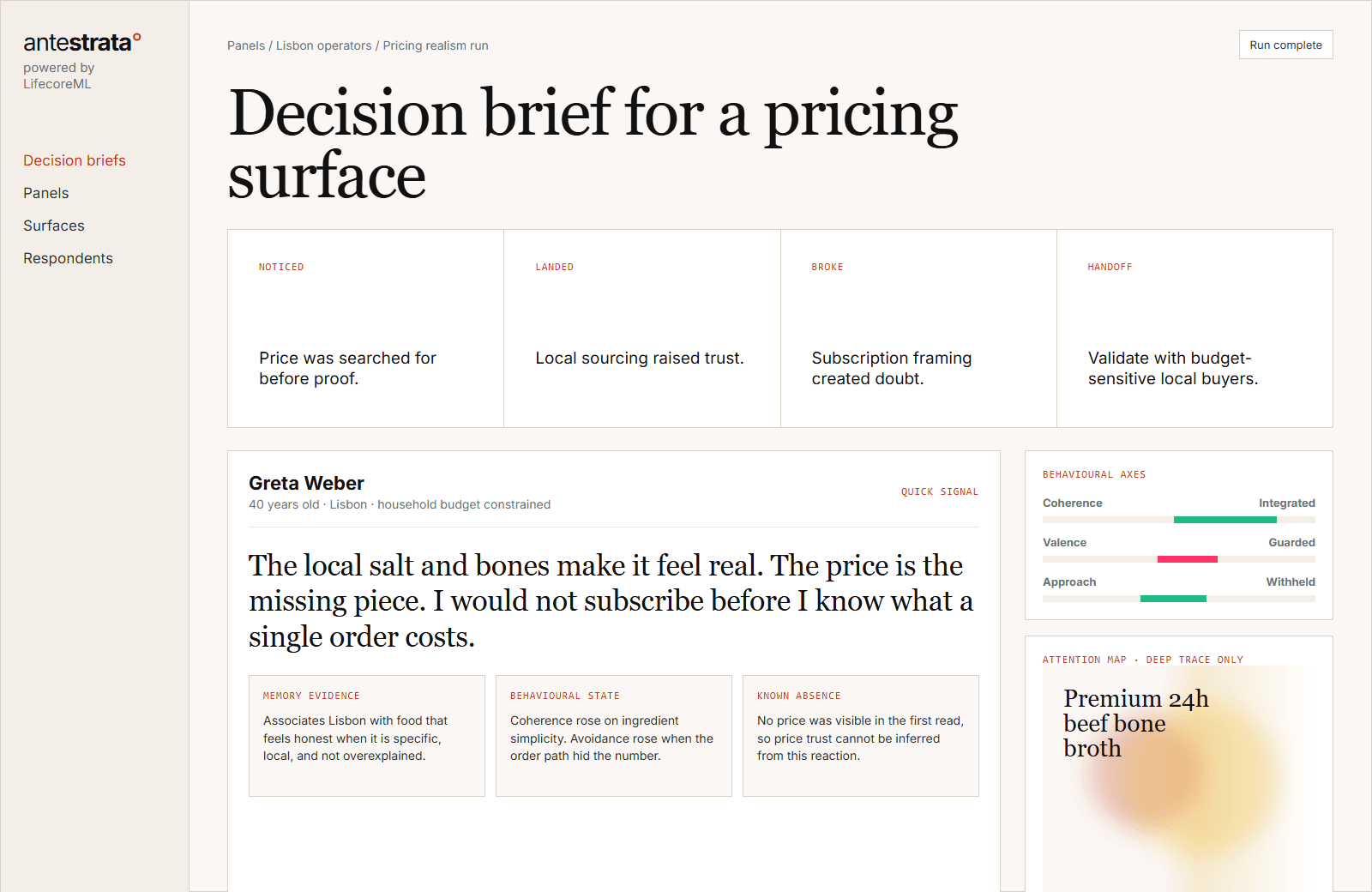
Decision brief for a pricing surface

Noticed

Price was searched for before proof.

Landed

Local sourcing raised trust.

Broke

Subscription framing created doubt.

Handoff

Validate with budget-sensitive local buyers.

Greta Weber

40 years old · Lisbon · household budget constrained

Quick signal
The local salt and bones make it feel real. The price is the missing piece. I would not subscribe before I know what a single order costs.

Memory evidence

Associates Lisbon with food that feels honest when it is specific, local, and not overexplained.

Behavioural state

Coherence rose on ingredient simplicity. Avoidance rose when the order path hid the number.

Known absence

No price was visible in the first read, so price trust cannot be inferred from this reaction.

03 · How it works

The product stays small enough to inspect.

One run has one surface, one respondent panel, and one decision brief. That boundary is what keeps the evidence useful.

  1. 01

    Choose the respondent panel

    Start with saved respondents or assemble by geography, age, income, education, literacy, technology readiness, and behavioural disposition.

  2. 02

    Show the surface

    Keep the object bounded: a page, deck, message, pricing flow, campaign, static visual, rough concept, or app journey.

  3. 03

    Read the reactions

    Each respondent reacts from prior state. The voice layer narrates the reaction, but it is not the source of the respondent.

  4. 04

    Use the decision brief

    Turn individual reactions into revision paths, evidence gaps, and the real-user handoff.

04 · Product preview

A decision brief should answer five things.

Decision brief preview showing noticed, landed, broke, handoff, memory evidence, behavioural state, and known absence.
Decision brief preview: individual reaction, memory evidence, behavioural state, known absence, and run boundary.

Noticed

Which claims, visuals, prices, proof cues, and gaps entered the read.

Landed

What became believable, useful, desirable, or clear.

Broke

What damaged trust, confused the offer, or made the ask feel too early.

Hesitated

Why the respondent slowed down, bounced, searched, or asked for another route.

Next

What to keep, remove, rewrite, validate, or test with real users.

05 · Run depth

Quick signal reads. Deep trace encounters.

Depth changes the evidence contract and the credit estimate. Quick signal is the default for cheap iteration.

Quick signal

1 credit per respondent

Cheap iteration when you need one grounded read from each respondent.

  • Surface extraction
  • Memory-grounded reaction
  • Behavioural state movement
  • Decision brief summary

No encounter trace. No attention map.

Deep trace

Estimated before the run

Pages, decks, flows, and app journeys where path choice can change the finding.

  • Rendered encounter
  • Scroll, dwell, click, and bounce evidence
  • Stacked memory and state movement
  • Attention-map style evidence

Attention-map style evidence is not eye-tracking.

Interactive flow

Bounded before it starts

A deeper app journey where respondents choose, continue, stop, or enter safe test data.

  • Branch limits
  • Form and privacy policy
  • Screen-by-screen reaction trace
  • Journey-level credit estimate

No open-ended crawling and no hidden private-data capture.

06 · Evidence contract

Traceable does not mean omniscient.

The product shows why a reaction happened without pretending every hidden route or private memory was observed.

Evidence contract
Buyer needProduct answerEvidence shown
Why did that reaction happen?Memory evidence is paraphrased for the decision brief.Memory is shown as a relevant life episode, not dumped as private prose. A food memory can become a cue such as associating Portugal with better everyday food than Manchester.
Did the respondent see the thing?Known absence is evidence.If no price was seen, no branch was reached, or no strong memory fired, the decision brief says so.
Did the reaction change state?Behavioural axes show movement during the read.Coherence, valence, arousal, dominance, avoidance, and self-other focus stay attached to the reaction.

07 · Method boundary

LifecoreML is the engine. The voice layer is not the respondent.

The public claim is specific and bounded: respondents are composed before the surface appears, then narrated from prior respondent state.

Respondents exist before the surface appears.

LifecoreML composes respondent state first. The read begins after that state exists.

The voice layer narrates.

The voice layer turns prior state and reaction into readable first-person language. It is not the source of the respondent.

The grammar stays private.

Public proof shows output, evidence, stable respondent identity, and repeatability. It does not publish private composition rules.

Read the methodology

08 · Real-user handoff

Spend artificial attention first.

No artificial read replaces real users. It makes the live session sharper before real people spend scarce attention on an unfinished surface.

  • Which real users to validate with next.
  • Which questions to ask them.
  • Which claims survived the artificial panel.
  • Which proof gaps need repair before live attention.

09 · Public boundaries

The artificiality is the feature.

No real person is copied.

No real identity is reconstructed.

No customer surface trains a shared model.

No artificial read replaces real users.

10 · Pilot

Bring the surface that keeps returning to the meeting.

Start with one surface, one respondent panel, and one decision brief. Revise before the real users see it.

Request a pilot